
How NCAA Track and Field Can Fix Its Championship Format and Raise Revenue
Jaleel Croal just ran 9.75 seconds in the 100 meter dash for South Florida at the American Conference Championship meet. Yes, it was wind-assisted. But still — 9.75. Then Eddie Nketia of USC went even faster, running 9.74 seconds in the 100 at the Big Ten Championships. Also wind-assisted, but again, that is a ridiculous performance in a college uniform. And yet, unless you are deep inside the college track and field world, you probably barely heard about it. That is the problem.
Elite Performances Are Happening Everywhere
This was not just about two wind-aided 100 meter times. Jelani Watkins won the SEC 100 meters in a wind-legal 9.95 and came back to run a wind-legal 19.87 in the 200. That helped Arkansas win the SEC title, and right now Arkansas looks like one of the strongest teams in the country. On the women’s side, Adaejah Hodge ran 21.92 in the SEC 200 meters for Georgia. Madison Whyte ran 21.78 wind assisted for USC at the Big Ten meet. Brianna Selby ran 10.74 wind assisted in the 100. These are not normal college performances. These are world-class results happening across conference championship weekend. But the sport does not have a structure that makes those performances easy to follow, easy to sell, or easy to care about beyond the people already watching.
Conference Titles Should Matter More Than They Do
The issue is that winning a conference championship in NCAA track and field does not really move a team forward in a meaningful national championship structure. A team can win its conference and still be done. If the athletes are not individually qualified to regionals, their season is over. If they do qualify, they still have to survive regionals as individuals. The team title picture does not flow naturally from conference championships to regionals to nationals. That creates a strange incentive system. Some programs no longer have to care that much about winning conference meets. If they have a few national-level athletes who can qualify through regionals and score big at the NCAA Championships, they can finish high nationally without necessarily being a complete conference championship team. That might be good strategy under the current rules, but it is not good storytelling.
College Track Needs a Real Postseason
College basketball works because the path is obvious. Win your conference, and you go dancing. Even small-conference teams matter because they enter a bracket. Fans understand the stakes immediately. Track and field does not work exactly like basketball, but the same basic idea can apply. If a team wins its conference championship, it should earn a place in a national championship structure. That does not mean every conference champion is good enough to win the NCAA title. That is not the point. The point is that winning should lead somewhere. Right now, too many conference trophies feel disconnected from the national championship race.
A Regional Championship Model Could Fix the Story
Instead of the current East/West regional model, I would build the postseason around the existing NCAA Division I track and field regions. There are nine regions. Each region would hold a regional championship meet. Conference championship teams would earn automatic bids into their regional. Top teams based on national TFRI data could also be protected so the best teams are not left out. Individuals who win conference titles or rank high enough nationally could still compete, even if their teams do not qualify. But here is the key distinction: If the team does not qualify, the athlete competes as an individual. They can still earn All-American status. They can still win medals. They can still prove they are one of the best athletes in the country. But they should not be scoring team points for a team that did not qualify as a team. That is already how cross country works. Individual athletes can qualify without their teams. The athlete gets their recognition, but the team title is still a real team title.
A 16-Team National Championship
From the nine regional championships, each regional winner would automatically qualify for the NCAA Championship meet. That gives you nine teams. Then the remaining seven spots would go to at-large teams based on regional weekend performance data. Use the same kind of TFRI logic that already exists. Score the teams, compare performances, and fill out the 16-team national championship field. Now every region is represented. The best teams still get in. And suddenly, there is a real bracket-style storyline. Who won their region? Who got an at-large? Who was on the bubble? Who got left out? Which small-conference team earned its shot? Which power conference team failed when it mattered? That is the kind of structure fans can actually follow.
The Regional Fields Would Create Real Stakes
A South Central region with Arkansas, LSU, Texas A&M, Texas, Houston, Texas State, Tarleton State, Stephen F. Austin and Central Arkansas would immediately mean something. Arkansas, led by Jelani Watkins, would have to show up and win. In the West, Oregon, USC, Washington, Arizona State, Arizona, Cal Poly, Washington State and Long Beach State could create something that feels like a real postseason meet. In the South, SEC depth would make the region brutal. Georgia, Tennessee, Auburn, Alabama, Florida, Ole Miss, Mississippi State, Florida State, Southern Miss, Kennesaw State, Sanford and Jackson State would create legitimate pressure. That is how you create stakes. Not just time trials. Not just “let’s see who qualifies.” Actual team pressure.
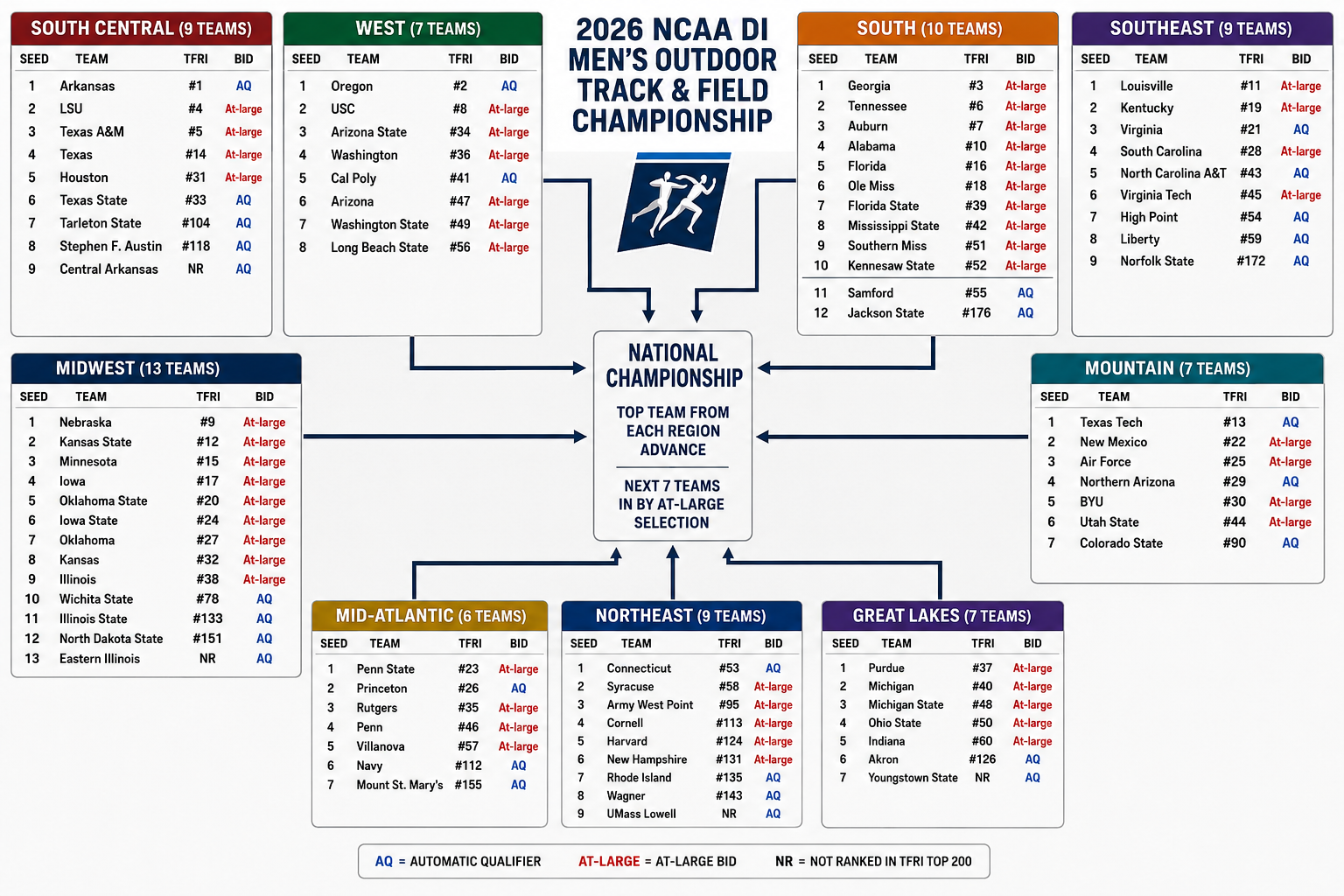
Mock D1 Men’s Outdoor Track & Field Championship Bracket for 2026
The Bubble Would Finally Matter
One of the best things this model creates is a real bubble. In the mock version, teams like Southern Miss, Kennesaw State, Long Beach State, Villanova, Syracuse and Indiana could be among the last teams protected or included. Then teams like Oral Roberts, South Florida, Tulane, Georgetown, Colorado, UCLA, Middle Tennessee and California could be the first ones out. That gives the sport something it badly needs: Debate.
Who deserved to get in? Who got robbed? Which conference was stronger? Which team should have won when it had the chance? That is how sports conversation works.
The Women’s Side Might Be Even More Interesting
On the women’s side, the same structure would create massive regional stakes. Georgia could enter as a top overall seed, but the South region would still include teams like Florida, Tennessee, Alabama, Auburn, Ole Miss, Miami, Florida State and Mississippi State. The South Central region could feature LSU, Texas A&M, Arkansas, Texas, Baylor, Rice, Tarleton State, Texas State, TCU, Southern, Northwestern State and Central Arkansas. That is not just a qualifying meet. That is a real championship stage.
And again, the smaller conference teams matter because they earned their way there. Maybe they do not win. Maybe they get smoked. But they have a path, and the audience can understand why they are there.
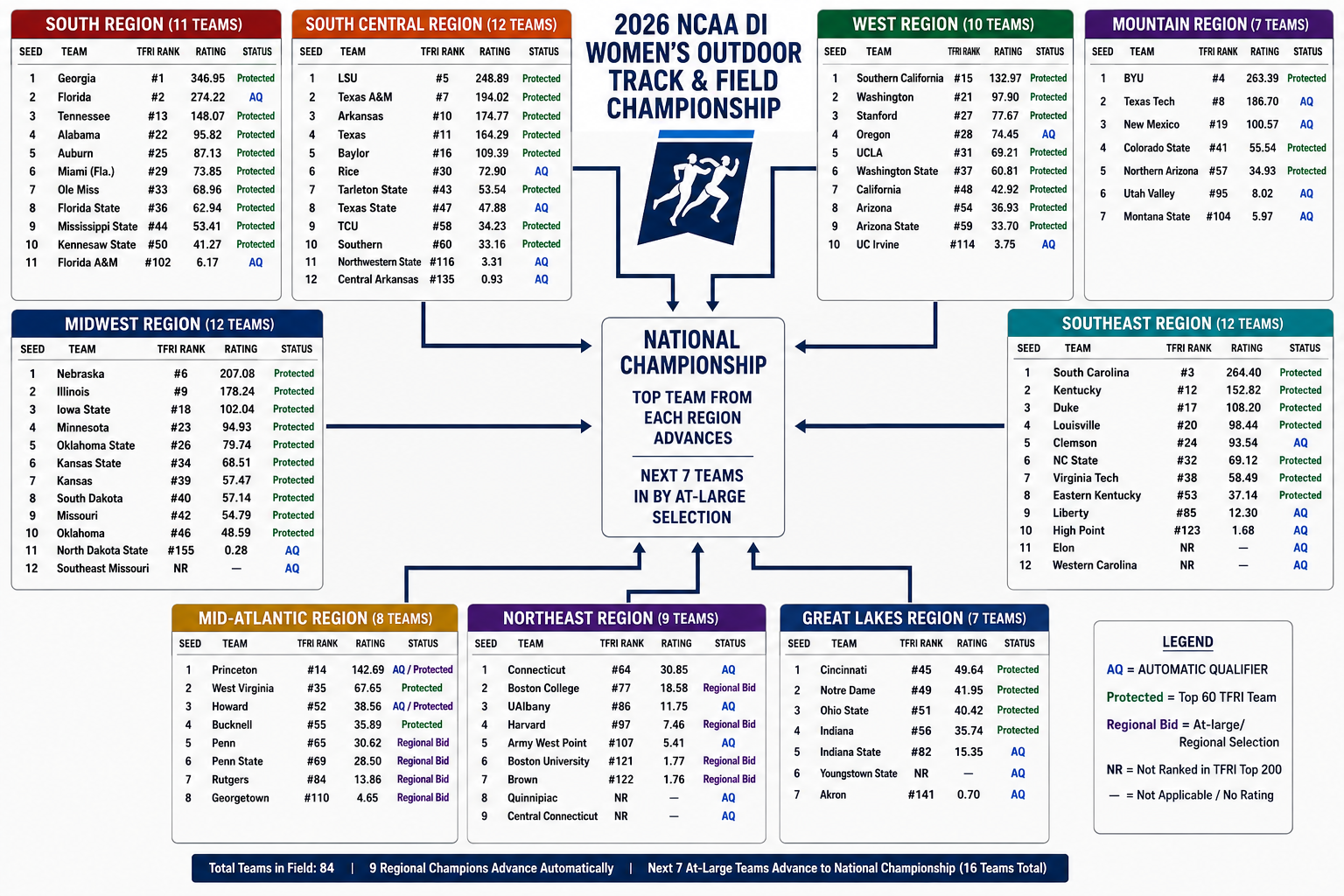
Mock D1 Women’s Outdoor Track & Field Championship Bracket for 2026
Individuals Still Get Their Moment
This model does not punish great athletes on weaker teams. If a sprinter like Jaleel Croal deserves to compete nationally, he should still compete. If a hurdler like Bradley Franklin is one of the best in the country, he should still be on the national stage. If a thrower is carrying a smaller program’s national ranking, that athlete still deserves recognition. The difference is simple: The individual can still compete as an individual. But if the team is not good enough to qualify as a team, that athlete should not be dragging the team into the team title race by themselves. That would make the NCAA team championship feel more like an actual team championship.
The Sport Needs a Better Product
College track and field has the talent. That is not the issue. The issue is that the sport does not package the talent in a way that makes the stakes obvious. Meets last too long. Scores are hard to follow. Conference championships do not naturally connect to nationals. The best athletes are scattered across events, conferences and regional systems that casual fans cannot easily understand. That is why performances like 9.75, 9.74, 19.87 and 21.78 can happen, and most people still do not know what to do with them. The sport does not just need fast times. It needs a story.
College Track Can Be Bigger Than This
A regional championship model would not solve every problem, but it would give college track something it desperately needs: a postseason people can follow. Win your conference, and you get a shot. Win your region, and you go to nationals. Perform well enough, and you can still earn an at-large bid. Miss the cut, and now we have a bubble conversation.
That is how you create stakes. That is how you create narratives. That is how you give athletes, coaches, programs, and fans something to actually follow from conference weekend all the way to the national championship. College track has the performances. Now it needs a format worthy of them.
SEE WHO THE BEST COLLEGE TEAMS ARE
View the SCA Team Rankings for D1 Track and Field